Wednesday, 8 January 2014

39.4 Business Plan

As an introduction, I realised after writing some of this that this business plan would be a lot more lucrative if I wasn't in college and had a music degree so for the sake of this assignment, I'm going to imagine myself aged 21.

Service:

The service that I'd like to provide is guitar lessons in the local area. I want to start this business because in the past I've been very lucky to have several extremely good and devoted teachers and I'd personally love to educate others myself. I believe that I've been playing guitar long enough to feel confident teaching beginners or even quite proficient guitarists. I'd like my teaching to be informal and relaxed and mainly be focused on teaching technique and how to play songs rather than theory.
I'd prefer to travel to the houses of the people I teach as I think that learning in your home is a much nicer atmosphere than travelling to my house or a local space I'd have to hire out.

My mission statement is to provide high quality and fun guitar lessons at an affordable cost.

In order to stay true to that mission statement while still maximising profits I need to try and expand my business to more customers but I can also do some things on the side such as making some tuition material that I could sell or providing instrumental loans.

A different route I may also consider is being affiliated with a school instead.

Target Market:

I don't know of many people that would be entirely happy with being taught by someone vastly younger than them so to be honest I'd be aiming to teach children and teenagers instead of adults. My main target market would be students at local secondary schools and colleges but I would consider extending to primary schools and university students. Bearing in mind that I'd have to travel to them I'd probably only teach within a 15 mile radius of my house. If I wanted to work at a school instead I'd much prefer to work at a secondary school.

My local area, Haywards Heath, has two large secondary schools and several primary schools. Within a 5 mile radius there are at least 17 primary schools. There are two music shops, one that caters for a wide variety of genres including classical instruments and one which specialises in rock music and electric guitars. The noticeboards of two music shops are definitely a useful advertising space to have very nearby. Also there are very small venues in the nearby area.

There are some disadvantages however. My area isn't without competition, I know of several guitar teachers in the area already that run very successful business and there is also the aforementioned "Rok Skool" which could be a major competitor. Other things I have to keep in mind are travelling times and parking fees, which could run up extra costs.

I did some market research in the form of a 7 question survey, the answers of which are below:


The results here show over 72% of guitarists that answered my survey where aged 16-20. This shows that I may have an older market than what I originally anticipated.


 50% of guitarists have been play less than 5 years which means they could still very much benefit from learning new things.


The most popular way that people have learnt guitar in the past is by guitar lessons outside of school. People also use online tab websites a lot so maybe I could earn more money by making a website with very cheap high quality tab for people to download or something similar.


The most popular genre of music that people play is unsurprisingly rock by quite a large margin. This is a good thing for me as it is undoubtedly the genre I would feel most comfortable teaching.


50% of people live in my nearest town which is great as I'll spend less money on petrol that way. A lot of people live in Brighton however. Other responses showed people living in East Grinstead and Albourne which are both fairly local.

The most popular response was that people like guitar lessons. Almost 1/5 of guitarists love them! Over 95% of people fall somewhere between feeling indifferent and loving guitar lessons.


This is the most surprising result in my opinion. The majority of people would actually rather travel to me. I may not need to buy and maintain a car and could save thousands by finding a place to hire out such as a school.

Development:

As I'm aiming to travel to people I need to include the cost of getting a car in my budget. I have to buy a car, lessons and insurance which will cost a few thousand pounds. As I'm teaching teenagers in full time education, my working hours will need to be weekdays from about 4pm onwards, preferably early evening. I'd consider doing lessons on weekends and definitely during school holidays.

If I were to become affiliated with a school, I would teach 30 minute lessons throughout the entire school day. Lessons needn't be 1-2-1 either, my old secondary school used to have a similar system where two kids would be paired and be taught together. On the side, I could also run a "Rock Orchestra" that kids at the school could join. It's essentially a massive band with multiple guitarists and bassists. Parents would pay a termly fee and the kids would get to perform at school concerts. At £6.50 a week per kid for 90 minutes and the fact there can be between 15-20 kids, an extra £97.50-£130 per week is fairly profitable. Schools welcome after school activities as it enriches their students education.

There is a business in my area called Rok Skool where kids pay to have guitar lessons, get put in bands, write songs with people and play gigs. Another possible source of income from teaching guitar would be to try and get a job at a business like that. I think that the more sources of income I have from teaching guitar the better. I see no reason other than time management why I couldn't manage self-employment, working at a school and working at a rock school.

To grow as a business I'd get business cards and other advertisements to share and put on local noticeboards etc. I'd also try and market myself online by making a website, facebook page and twitter where I could easily advertise and communicate with people. I could also make posters which could be effective marketing. On Vistaprint.com, prices start at £9.99 excluding VAT for 250 business cards.

It may take time to set up the business before I even start teaching. If I wanted to start the ball rolling right now, it would take at least 5 months to get a car, learn to drive and pass my test. During that time frame I could prepare all my teaching material, set up my online presence and get all my business cards and ads together.

Legal Aspects:

If I want to work at a school  I need to get a DBS check (used to be called CRB) so that I'm allowed to work with children. A standard DBS check costs £26. Also if I teach lessons at other people's houses, I need to get public liability insurance so that I'm covered if there are any accidental damages. The Incorporated Society of Musicians (ISM) costs £12 for a subscription if you're studying for a degree in any area of music, £65 if you've graduated, and £164 if you don't have a degree or diploma. The ISM offers 24/7 legal support and expenses cover for up to £100,000, tax support, advice and £10,000,000 public liability insurance and another £10,000,000 again for employers liability insurance. In order to have proper car insurance cover for my business, I need to get business car insurance. Typically this costs more than regular car insurance so i'll try and keep costs down by using  a service like moneysupermarket.com to compare insurance rates. Also, as far as I know, costs can be lowered by having a box fitted in the car that monitors your speed so the insurance is lower if you don't travel at excessive speed.

Financial Aspects:

Aside from the initial cost of sorting myself out with a car, there's also the price of petrol itself that I'd have to buy. I'd have to buy a small portable amplifier to take with me and I'd probably consider buying a hard case for my guitar. I may need to buy guitar accessories such as cables, straps and guitar picks in case they get broken or lost during my lessons.

With that in mind, to turn a profit I'd charge £25 per hour for hourly lessons and £13.50 for half an hour. I'd try and include flexibility in my prices: regular customers would get every other week of hourly lessons for £20. If someone didn't want weekly lessons I could arrange biweekly lessons instead. I would make sure to let people know that any lesson cancellations within 24 hours will still cost full price as I think it's fair that I take precautions so I don't lose too much money.

The idea I discussed previously of working at a school is actually very profitable. Potentially I could teach 10 half hour lessons per day, 5 days a week, 36 weeks a year. If I organised a "Rock Orchestra" on top with 20 kids that adds up to £28,080 annual turnover.

If I earn under £32,010 per year, I'll have to pay 20% income tax to HMRC but if I manage to earn over that, I'll have to pay 40%. Furthermore, if I'm self employed, I'll need to pay class 2 and class 4 national insurance which amounts to £2.70 a week as well as 9% on profits between £7,755 and £41,450. If I do have an employer, If I earn between £149 and £797 a week, I have to pay 12% of that and if I earn over that I have to pay an extra 2% on those earnings.

It may be worth hiring an accountant to help me with all of this. According to an article in The Guardian newspaper, hiring an accountant for basic book-keeping and sorting simple tax affairs shouldn't cost more than £200-£300 per year.

Business Proposal:

This is a link to a thorough business plan that should be donwloaded because it looks terrible in mediafire. It shows a 5 year projection of the business, my yearly incomings and outgoings and shows final yearly profit for each year.


Thursday, 7 November 2013

Guitar Technician

A Guitar Technician (Guitar Tech) is part of a musician's or band's road crew who looks after and sets up guitars for one or more guitarists. A guitar tech may also be responsible for amplifiers and effects pedals as well as electric or acoustic guitars. They must have basic guitar playing skills, an ear for tuning and a good idea of how the equipment is supposed to sound in the style of music the band is playing. [1]

Becoming a guitar tech might start from being interested in guitars and wanting to help out a friends band. Many guitar techs may have taken courses in guitar repair at a college or lutherie school. The salaries and working conditions vary depending on whether the band is unsigned and doing a small regional tour or if they're a major international touring act. [1]

A guitar tech has two main jobs to perform: Setup & Soundcheck and Maintenance & Repair

Setup & Soundcheck

Before a show, guitars need to be strung and tuned with an accurate electronic tuner. A guitar tech needs basic guitar playing skills and an ear for tuning to strum some chords on the guitar to ensure it's in tune. Guitars need to be carefully placed on racks, straps need to be securely on and cables securely connected.

During a show, a guitar tech needs to be ready to hand any instruments to their guitarist(s) that they may require. This may be due to an unfortunate technical failure or string snap or may be preference for a different sound for a different song. Every guitar needs to be re-tuned again before the guitarist needs them because strings tend to slacken due to hot stage lights or humidity. A guitar tech may hand towels to the guitarist to clean sweat from their hands which corrodes strings and other things like bottles of water. Guitar picks may also need to be set up in easy to access places such as double-sided taped to amps or mic stands.

After a show, cables are unplugged, all instruments are cleaned and packed back into their cases.

Maintenance & Repair

On a guitar there are plenty of important variables that need to be maintained: string action, fret dressing, intonation etc. Valves on valve amps need to be checked along with cables and batteries on effects pedals, tuners and pre-amps. Any crackles or buzzing (or silence) to do with any equipment is checked and repaired by a guitar tech after troubleshooting. A guitar tech often has to be a jack of all trades. They need to be good at electrical repairs (e.g. re-soldering loose connections inside guitars), swapping out damaged speakers, repairing damaged guitars and other similar tasks. If a guitar is beyond repair, it is a guitar tech's duty to find a replacement guitar or part. Of course there is regular restringing of guitars which on a tour is often before every show.


The conditions of work for guitar techs vary a lot. Some guitar techs for much smaller acts may set up guitars for all of the performers. They may also have to take on tasks beyond guitar tech work such as helping to set up sound equipment or soundcheck the mics. On the other hand, guitar techs for huge international touring bands may be part of a large road crew team which includes amp techs and guitar techs for each guitarist. In short, they may have less to do as there will be more members of staff to carry out specific jobs.[1]
The salary can vary hugely depending on who a guitar tech is working for. If you start out working for a small local band that you know to gain experience then you might just work for a cash payment rather than having a proper salary. In small touring acts the guitar techs may be paid through a simple contract during the tour. and there may not be health or dental benefits. They might even have to have another more permanent job and tech on the side when their band is on tour. A guitar tech for a band on a short regional tour may stay in cheap motels whereas a guitar tech travelling with Green Day, for instance, may stay at the same 5* hotels as them and eat catered buffet meals or have their own catering crew. The guitar techs for the most famous international guitarists such as Jimmy Page can become a minor celebrity within the guitar enthusiast community because of their close contact with musicians who are considered to be 'rock legends' and for their in depth knowledge of how a certain guitarist's unique tone is created.

Artist/Performer

An Artist/Performer is someone who performs music solo or in an ensemble (and often composes too).

Being a successful musician is arguably the most glamorous job in the music industry. Take The Rolling Stones for example, their band name has become synonymous with living the high life, fame, wealth, drugs and partying. The success usually doesn't come easily and being in a very small time band can be extremely hard work with very little pay. Early on in his career, Green Day front man Billie Joe Armstrong lived in a slum. Lower Than Atlantis front man Mike Duce worked at Morrisons full time while playing in his band in the evenings.

How To Make It In The Music Business by Siân Pattenden states that being a "Pop Star" is a 24/7 job that has enormous health risk, pressure, constant travel but is extremely glamorous. "It's a rotten job, but lots of people want to do it."

There are vary clearly defined pros and cons with being an artist and I'll try and bullet point as many as I can think of. Often some things like fame can fall under both categories depending on who you are. It's often nice to be in the spotlight but if you make mistakes or do something embarrassing, it can be a curse as well as a blessing. Not to mention the paparazzi.

Pros:
  • Fame
  • Wealth (Paul McCartney is worth an estimated $800 million)
  • Sense of achievement
  • Having a loving, loyal fan-base
  • The satisfaction that comes from giving enjoyment to others
  • Job satisfaction (Ultimately making music is what a successful artist loves the most)
  • Being in a band (Spending most your time with a group of your best friends)
  • Making music, on your own or as a band
  • Feedback from the audience (This little section from Bring Me The Horizon's set at Reading is the most recent thing I've seen showing what I mean)
Cons:
  • Loss of freedom
  • Loss of privacy
  • Pressure (and similarly the pressure that deadlines create)
  • The stress of performing
  • Constant travelling
  • Extreme tiredness
  • Being tempted into a life style of drugs and alcohol (and dying when you're 27)
  • Being away from family and friends for long periods of time
Artist/Performer is a very broad job role and there are many different settings that the artist will find themselves in. Performing at the O2 arena will perhaps require a tighter schedule and the artist may feel more pressured than if they recording at a studio. The artist will need to perform at rehearsals too and if they are a songwriter as well then that's another part of the job. At each setting, the artist is essentially just playing their instrument/singing, however, depending on what they're doing and where they are, the job can vary immensely. Performing a one off massive show is also very different to a long tour. Playing two sets at Reading and Leeds on two consecutive days is going to be very different to playing much smaller venues on a tour for two months. The stage at a festival is going to be much bigger and more elaborate, there will be more members of stage crew, more lights, a more complicated sound rig for instance. It will be louder and there will be a much bigger audience. Often, depending on whether you're headlining or not, you might be filmed live for a television channel. You will probably have a smaller setlist too (again depending on whether you're a headliner) which means giving a performance your all for say 45 minutes, rather than playing a 90 minute set where you can take short breaks or play slower, calmer songs.

After your wonderful performance at Reading, magazines, television channels, radio stations and newspapers are probably going to want to interview you. Public relations are very important and if you want people to buy your songs and listen to your music, you have to show the public what you're like. Having a fan base is incredibly important. Lots of artists have social media platforms such as twitter and reach out to the fans while they're on tour. It's really quite beneficial for fans to feel like the bands they listen to consist of real people just like them that they can connect with.


Other public appearances that an artist might have to make include live television performances and (if you're lucky) award ceremonies.

Not every part of the job is public though. After all, the music business is a business and there will definitely be meetings with record labels, publishing companies, lawyers, accountants and managers etc that the artist will have to attend.

Compared to other jobs involving live performance, being the performing artist that's the center of attention comes with increased rewards but the pressure might be too much for some. A session musician on that very same stage with the aforementioned artist may feel much less pressure. I'm probably correct in assuming that at least 75% of the audience don't know the names of the session musicians sharing the stage with the famous band they've gone to see. Session musicians will be paid less than the main act unfortunately but there are interesting differences between the two. A session musician might only be contracted short term (for say a tour) before going to work with a different band or artist. The change in scenery so to speak is probably very refreshing as sharing a tour bus with the same people for months on end can be pretty purgatorial. On the complete opposite end of the scale, there are guitarists like Jason White worked with Green Day as a session musician for 13 years before they actually made him a member of the band. A session musician might only perform live, or might only work in a studio. It could be said that they have more freedom over exactly what they want to do as musicians without gigantic record labels on their back steering them towards doing what will make the most money.

An important aspect of any job in the music business is contracts and artists will have to sign lots of different contracts throughout their career, including but not limited to:

Publishing Contracts (Anything from a single to a whole album)
Recording Contracts (Again, anything from a single to a whole album)
Record Label Deals (Signing to a label)
Artist Management Contracts
Artist Venue Agreement

The length of these contracts can vary from between one page for a simple agreement to perform at a venue to around 50 or more pages for a long-term Artist/Record Label deal.

The following contracts are scans from How To Succeed In The Music Business by Allan Dann and John Underwood:


This contract is an example of a short agreement given to an artist or his manager to sign for a specific booking or a series of bookings like a tour.

Clause 1 is very straightforward. It's just an agreement of where, when and for how much the artist will be playing.

Clause 2 goes into detail about timing. It outlines when the artist has to arrive, how long their setlist is and when it ends.

Clause 3 should really be watched out for. The normal radius in an agreement like this is about 15 miles and if you are a little known band playing lots of small local venues nearby, this is unreasonable for the venue to make you agree to this. As a small band or artist, you should definitely try and get this deleted before you agree to play. This normally only exists for gigs where a good turnout would be noticeably affected by you being billed to play another local venue around the same date.

Clause 4 lacks some detail that is worth asking about; ultimately you want the salary paid in cash on the night.

Clause 5 is also very straightforward.


This is an example of an incredibly unfair contract you should never ever sign. It is extremely exploitative and unfair. Technically you couldn't be held to it because it is so unfair and ambiguous but it's a good example.

Clause 1 metaphorically sells your soul to this company. It says that you are never allowed to "render your services to another party for any purpose whatsoever".

Clause 2 says the company can rename your band to anything they want at will and the artist is entirely responsible for any lawsuits that may ensue.

Clause 3 forces the artist to go anywhere the company wants within 30 minutes "reasonable" notice. If they don't attend the times and places the company decides the artist loses all their rights under this or any other agreement.

Clause 4 gives the artist a really low royalty rate for their songs. 1% or less because the company has the full decision to make any deductions they want.

The artist could be fooled by Clause 5 if it was glossed over. If the artist is a duo the entire royalty rate is halved first before being paid to the artist.

Clause 6 is obviously a way of denying the artist any access to their money.

Clause 7 says that the artist has to pay all of the expenses involved in production, manufacture, distribution and advertising of their records. If they are unable to pay due to bankruptcy then relatives and friends must pay.

Clause 8 is straightforward but extremely unfair as the artist has to go abroad to get money for the company.

Clause 9 makes the artist agree that they have had no legal advice on this contract and they are not allowed to discuss any terms of the contract with any other party.

Friday, 27 September 2013

10 Years

I just replicated the earliest photo of me holding a guitar 10 years later. I can't believe it's been 10 years and I can't believe I've grown so much.


Thursday, 26 September 2013

Area 4: Artist Management

Being an Artist Manager is arguably the hardest job in the music industry. Your job is a constant 24/7 affair and you're under a lot of pressure. An Artist Manager puts themselves between the artist and the rest of the industry, any information directed at the artist is first filtered and tweaked by the artist manger and then told to the artist (and in most cases the manager will have to arrange all the logistics that comes along with that information too). Artists and their managers are in constant contact. This video uses the analogy of a wagon wheel to describe what's going on: the artist is the hub of the wagon wheel and the manager is the bearings and grease around the artist, the spokes represent areas of the artists career (e.g. recording, touring, publishing, merchandising, PR, record label etc). If any of the 'spokes' are broken or shorter than the others then the artists career can't keep rolling successfully and it's the job of the manager to make sure that the artist has the successful career that they want to have. Artist Management requires absolute commitment and it takes someone very dedicated to do a good job.

The cliché of the artist manager being part of the band is true as far as money is concerned. The manager is paid between 15-20% of the artists gross income, this means the manager can earn anything from peanuts to millions depending on the situation. For example if the manager was in charge of a 4 piece band and a record label had given £100,000 of advances to the band, £20,000 would go to each member and another £20,000 to the manager. 

From the managers point of view, there are definite pros and cons to their job. On the plus side, if you're manager of a hugely successful band, you get to travel first class with the band and go around in limousines, you get to go to huge launch parties and fancy dinners. To quote Chris Herbert [1] (Former manager of the Spice Girls) "The high points are when an artist succeeds and when you're thanked by that artist. When you're pulling up at Wembley and the name of your act is emblazoned across the front of it - they're the little moments that you give yourself a pat on the back for. All those kind of milestones, you share it with the act"

There are also a lot of negatives to being an artist manager. As I mentioned earlier, there is the stress and the constant contact you need to maintain with your artist. You might be called up any time of the day, any day. There's also the fact that the manager is often the first and easiest person to get blamed when anything goes wrong and they often get the least thanks too.


Area 3: Music Publishing Companies

Music Publishing has had to adapt a lot over the years. As the name suggests, traditionally music publishing dealt with the sale of sheet music. When the printing press came along, sheet music became susceptible to piracy. When records were commercially available, people didn't really have a need for sheet music as much because, instead of playing the music themselves, they could listen to an actual recording of the music in their own home. When radio became popular, publishing companies at first didn't know how to adapt because they thought that people wouldn't need to buy records anymore. After quite a long transitional process, nowadays music publishing companies make money from the use of music [1].

As a songwriter, music publishing companies can be of huge benefit to you. If you got a phone call every single time any radio station, tv channel, band, movie etc wanted to use your song, it would become impossible to manage and you would have no free time to get on with writing music. This is where music publishing comes in. In short, their job is to generate as much money as possible when others use your songs.

Music publishing companies are entirely separate entities from record labels but in some respects they work similarly. Music publishing companies have A&R people who go out to gigs in the evenings looking for artists who they think have good songs they could use in the same way record labels do. Music publishing deals also look very similar to record deals [2]:

  • Length of Contract
  • Assignment of Copyright: The company will have copyright of your songs.
  • Advances: Money the company will initially give you which you need to pay back before you start earning royalties.
  • Royalties: Money paid to you for the use of your music
  • Accounting: Set percentages and prices in the contract
  • Statements: Terms and conditions that the songwriter must agree with
You might be asking yourself  "Why would I want to give the rights of my music to a publisher?". It's a valid question but there are many positives to signing a publishing contract:

  • Advances
  • Administration and collection: (as mentioned earlier, the company will deal with the logistics of all the money you receive and they'll be the ones picking up the phone when people request the use of your music)
  • Promotional Assistance
  • Record Deals: often times it can be advantageous to get a publishing deal first and then, with the aid of the publisher, you can look for a record deal.
  • Films, TV & Commercials: Not only is this possible extra publicity of your music but you'll also be earning money for its use.
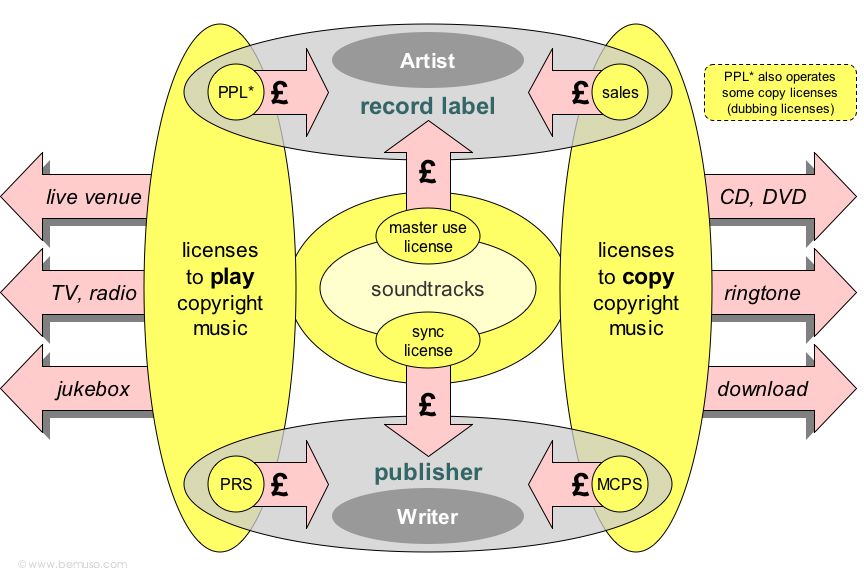
I'm going to try and go into more detail now on exactly how a music publishing company makes a songwriter money. This diagram shows where a songwriters royalties come from and how they are dealt with [3]:


This might look pretty daunting and complicated but it's actually fairly straightforward. There are 2 main ways in which your music can be used. It can be played or it can be copied. When it's played, it's dealt with by the PRS (Performing Rights Society) and when the record is being copied it's dealt with by the MCPS (Mechanical Copyright Protection Society). The MCPS for instance makes sure that the songwriter is given 8.5% of the sales of every CD made [4].

When bands are involved, songwriter's royalties are often split between members and percentages can vary based on how much they contributed. This can often cause conflict between band members later on [4].

Area 2: Record Companies

The job of a record label can be broken down into 5 simple steps:
  1. Find Artists
  2. Sign Artists
  3. Record Artists
  4. Promote/Market Artists
  5. Make money from sales of the Artist's recorded music
There are two types of record label, independent (indie) labels and major labels. The two are very different and despite most artists dreaming of being signed to a major, both have their advantages and weaknesses.

Since 2012, the major labels are Warner Music Group, Sony Music Entertainment and Universal Music Group. The world music market is absolutely dominated by the 'Big Three'. As of 2007, the major labels controlled 70% of the world music market [1]. Traditionally there has always been this complete control of the industry but recently the advances in technology and the rise of illegal music downloading has seen a dip in sales and many acts have been dropped.

A major label contract has a lot of different sections:
  • Advances. Money paid up front to the artists which later has to be recouped
  • Exclusivity. Once you've signed a deal with a major you are normally only allowed to record with that label exclusively and they own your copyright and the master copies of your records.
  • Territory. Major labels normally sign artists into a worldwide deal. This means their records will be distributed in many different territories across the globe. [2]
  • Term. This is the duration of your contract. Normally about 12 months with the label having the option to extend the contract if they wish. This also deals with how many records you have to make. [2]
  • Royalty Rates. The percentage of every record sale that you get as an artist. Artists only start receiving this after everything has been recouped.
  • Deductions. The amount of money deducted from your royalties to cover the cost of covers, sleeves and containers that the record is packaged in. [3]
  • Producers, Videos and Tour Support. The artist is expected to pay the producer a percentage of their own royalties. Tour support spent by the label also has to be recouped by the artist. Normally artists have to recoup 50% of music video costs as well. [2]
  • Websites.
  • Recoupment. Money that the artist has to pay back to the label before receiving royalties.
  • Delivery/Release Commitments. Artists have to commit to producing a minimum number of songs to be released by a certain deadline. [4]
  • Ownership of masters. The label normally owns the masters of the artists records.
Based on the sale of a £9.99 album released on Sony, this is how the money is divided [5]:


As you can see, this might not be considered the fairest contract as far the artist is involved seeing as they only get 1% more than the Tax Man.

With that in mind, I'm going to talk about Indie Labels and how they differ from the majors.
Each indie label is self sustained and isn't owned and controlled by a behemoth corporation. A lot of indie labels have been bought by major labels and although they retain some of their philosophies, they rely on financial backing from the majors. These labels are known as subsidiaries.

Indie labels might not be as lucrative for the artist as far as money is concerned, they allow much more creative control. As an artist signed to an indie, you can pretty much make whatever music you want with barely any interference from the label.

I did my own research and a lot of successful bands I listen to such as: All Time Low (Hopeless Records, Asking Alexandria (Sumerian), Bring Me The Horizon (Epitaph), Mallory Knox (Wolf at your Door Records), Of Mice & Men (Rise) are signed to indie labels. Bring Me The Horizon for instance have headlined Reading & Leeds Festival Main Stage. Even Paramore have remained signed to Fueled By Ramen Records (a Warner subsidiary).

An indie contract is often based on a 50/50 deal and can look something like this [5]:


As you can see, this is a lot fairer to the artist. Indie labels do have their disadvantages however. They lack the global power and contacts of the majors. They aren't going to be able find you the best producers or distribute your record globally to every supermarket in America. They also won't be able to market and advertise you as well. Another comparison between the majors and the indies is that whereas majors tend to prefer signing artists that are already successful, indies very often sign unknown artists that they see potential in. Artists can form a real partnership with indie labels, the label can help them build a fan-base locally and help the artist go on small tours and such. Also for an artist signed to an indie label, there is much less risk of being dropped.